MENU

ULTRASONIC TESTING FLAW DETECTION (UTFD)
Description
Advantages
Limitation
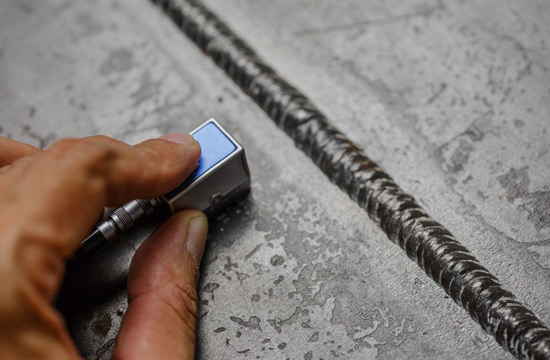
Ultrasonic Testing is a family of NDT techniques based on the propagation of ultrasonic waves in the material tested. In most common UT application, very short frequencies of UT waves ranging from 0.1 to 15 MHz and occasionally up to 50 MHz are transmitted into material to detect internal flaw or characterize materials.
Ultrasonic testing is a powerful non-destructive testing method used to detect and analyse internal and surface defects in a wide range of materials and structures.
From detecting hidden cracks in a component to measuring the thickness of pipelines, ultrasonic testing has become an essential tool for ensuring the quality and safety of critical infrastructure. However, like any testing method, ultrasonic testing has its advantages and limitations that must be considered to ensure accurate and reliable results
Advantages
- Higher penetrating power allows the flaw detection deep in the part.
- Higher sensitivity allows the detection of even extremely small flaws.
- In several cases, only one surface requires to be accessed.
- Higher accuracy than the other non-destructive testing techniques to find the depth of the internal flaws as well as the thickness of the objects having parallel surfaces.
- Has some capacity to estimate the orientation, size, nature and shape of the defects.
- Has some capacity to estimate the structure of different alloys of the components having different acoustic properties.
- Not hazardous to operate or to nearby people and doesn’t have an effect on the materials and equipment vicinity. The results obtained are immediate and hence the spot decisions can be made immediately.
Limitation
- Requires a smooth surface for accurate testing, and surface roughness can interfere with the transmission and reflection of sound waves, making it difficult to detect defects.
- Most effective on flat or regularly shaped materials. Irregular shapes, such as curved or cylindrical surfaces, can present challenges for accurate testing and may require specialized equipment or techniques.
- Most effective when the sound waves are perpendicular to the surface being tested. If the orientation of the material or the defect is not ideal, it may be difficult to detect or accurately assess the defect.
- Most effective on homogeneous materials with uniform properties. Materials with varying properties, such as composites or laminates, can present challenges for accurate testing
Find out how our Non-Destructive Testing service can help in ensuring the safety and efficiency of your equipment and assets maintenance and operation.
Contact UsENQUIRY FORM
ENQUIRY FORM
Enquiry form successfully submitted!
Thank you for your time, We will be in touch with you as soon as possible.